I’ve been cooking for years, but when I first tried sous vide, it honestly changed my kitchen game. Unlike the guesswork of traditional methods, sous vide gives me precision that’s almost unfair – perfect medium-rare steak every single time. No more hovering over hot pans or dealing with dried-out chicken. Yes, it takes longer, but I’m free to do other things while it works. The question isn’t really if it’s better, but when it’s worth the extra time.
How Sous Vide and Traditional Cooking Fundamentally Differ
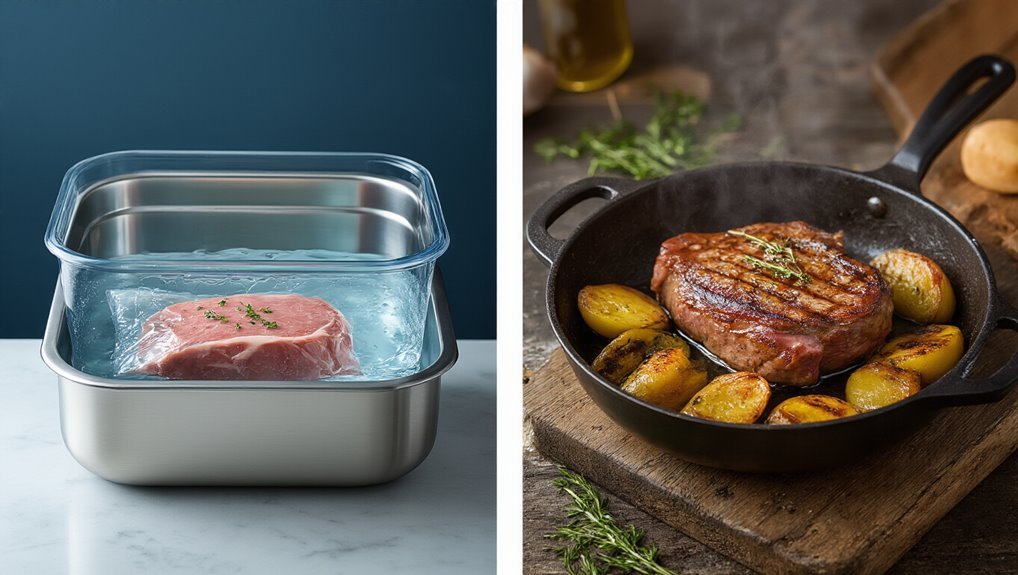
While I’ve cooked professionally for years, I think the differences between sous vide and traditional cooking methods are fascinating to explore.
At their core, they represent completely different approaches to heat transfer.
Traditional cooking exposes food directly to high heat, while sous vide utilizes bag chemistry to create a controlled environment where food cooks evenly in its own juices. The water bath design enables improved heat transfer efficiency, supporting precise temperature control and uniform doneness.
The magic of sous vide lies in its gentle embrace—food transforming through precise temperature, not fierce flames.
What really amazes me is how sous vide practically eliminates timing errors.
I’ve burned countless steaks on busy nights in restaurants, but with sous vide, safety procedures are simpler because temperature control is precise and consistent.
You know, it’s like comparing a paint-by-numbers to freehand art—traditional cooking requires constant attention and skill, whereas sous vide gives you that perfect doneness every time with less babysitting.
Though, I do miss the sizzle of a hot pan sometimes!
Precision vs. Variability: Temperature Control Compared
Speaking of control, temperature consistency might be the most striking difference between these cooking methods.
When I’m using traditional cooking, I’m basically eyeballing temperatures or relying on imperfect oven sensor calibration.
This leads to those frustrating moments where food edges burn while centers remain raw.
With sous vide, I get precision down to 0.1°C—it’s like having a personal temperature guardian for my food!
The water bath acts as an insulating buffer, eliminating those hot spots that can ruin dishes.
I think the most remarkable benefit is consistency between batches.
You know how sometimes one steak is perfect and the next is overcooked?
That variability practically disappears with sous vide because the temperature remains steady, preserving moisture and maintaining texture throughout.
This is why temperature consistency delivers repeatable results across batches.
Why Sous Vide Preserves More Moisture and Flavor
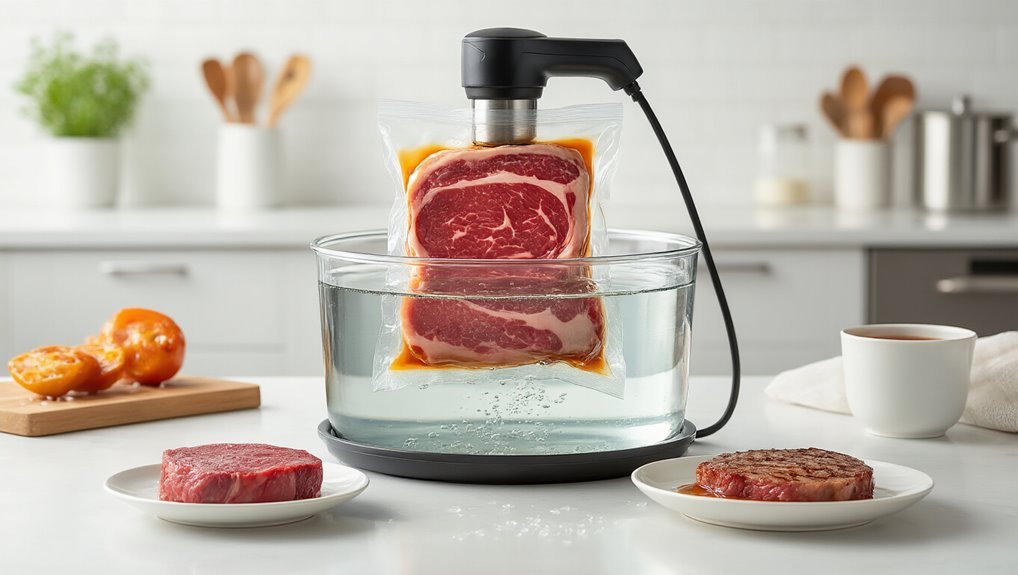
Because food is sealed in an airtight environment, sous vide cooking captures moisture and flavor in ways traditional methods simply can’t match. This is where air-tight packaging supports consistent moisture retention and reduces exposure to contaminants. I’ve found that the vacuum-sealed bag creates a humid little ecosystem where nothing escapes – juices stay put, aromas intensify, and the seasoning timing works differently than with traditional cooking.
| Sous Vide Feature | Moisture Effect | Flavor Impact | Texture Result |
|---|---|---|---|
| Sealed environment | Prevents evaporation | Concentrates aromas | Tender, juicy |
| Low temperature | Minimizes shrinkage | Preserves volatile compounds | Even consistency |
| Juice retention | Creates natural jus | No flavor loss to pan/air | Succulent outcome |
| No direct heat | No surface drying | Even seasoning penetration | No dry exterior |
You’re basically getting the benefits of braising without diluting any flavors. It’s like giving your food a spa treatment rather than a harsh workout.
Texture Transformations: How Each Method Affects Meat, Fish, and Vegetables
The texture of your food might be the most dramatic difference you’ll notice between sous vide and traditional cooking methods.
In my experience, sous vide creates this incredible uniform tenderness from edge to center, while traditional cooking often leaves you with that frustrating overcooked exterior and underdone middle.
The gentle temperature control in sous vide means perfect fiber breakdown in meats without the moisture loss you’d get from high-heat methods.
The method’s reliance on precise water bath temperature and vacuum sealing works to maximize flavor retention and moisture, a process built on vacuum sealing.
I’m constantly amazed at how vegetables retain their firmness rather than turning to mush—they stay crisp yet tender, which is almost impossible with conventional boiling.
What I love most?
You can still get that beautiful crisp formation with a quick sear after sous vide cooking.
It’s like getting the best of both worlds: perfectly tender interior with that satisfying textural contrast.
Time Investment: When Sous Vide’s Longer Cook Times Pay Off
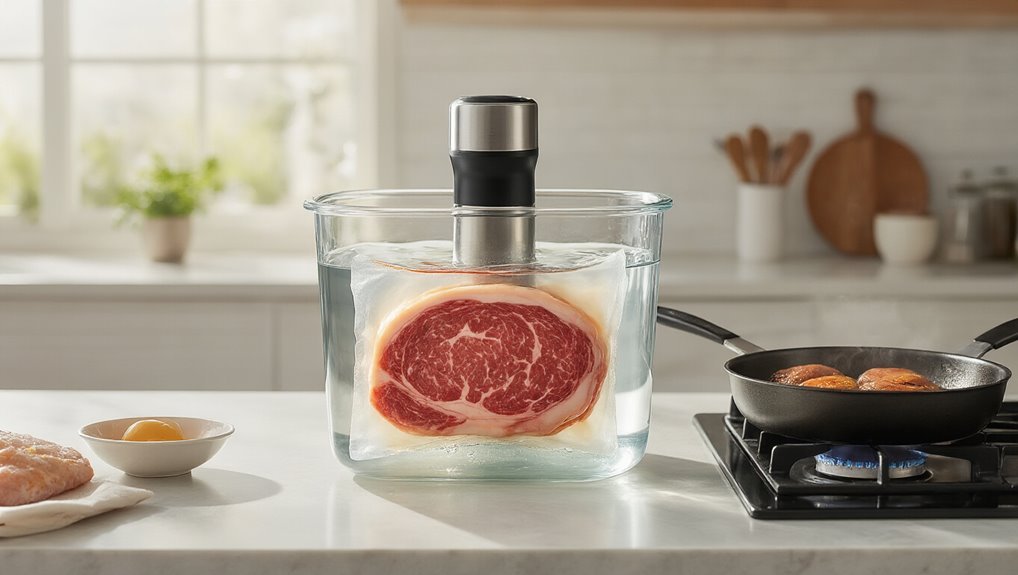
I’ll admit I was skeptical about sous vide’s lengthy cook times until I experienced firsthand how the hands-off nature frees me up to tackle other kitchen tasks.
This method hinges on vacuum sealing, which enhances heat distribution and preserves natural flavors. You’re not actually spending more active cooking time—you’re investing in a method that delivers consistently perfect results while you do something else entirely.
In my kitchen, I’ve found this patience pays off tremendously, especially when entertaining guests and I need reliability more than speed.
Patience Yields Perfection
While many cooks dismiss sous vide cooking as too time-consuming, I’ve found that patience truly yields perfection in this method.
When I first encountered the timing myths surrounding sous vide, I was skeptical too—who wants to wait 4 hours for a steak? But there’s a patience economics at play here that’s worth understanding.
The beauty is that while your protein slowly transforms, you’re free to do other things.
No babysitting required!
I’ve discovered that those extra hours allow collagen to break down at precise temperatures that traditional methods can’t maintain.
The result? Meat that’s uniformly tender from edge to center, juicier than you’d believe, and honestly, more flavorful.
For restaurants, running those tanks overnight even saves on energy costs.
Worth The Wait
Skeptics often ask me: “Is sous vide really worth all that time?”
My answer is an emphatic yes—when you understand what you’re gaining.
The patience payoff comes in what traditional cooking can’t deliver—edge-to-edge perfection without babysitting your food.
I’ve found that setting up a roast before heading to work means coming home to meat that’s exactly medium-rare throughout, not just in the center.
The waiting rewards you with moisture retention that’s simply impossible with conventional methods.
Think about it—when was the last time your traditionally cooked chicken breast remained juicy the next day?
Sure, it takes longer, but it’s hands-off time.
You’re not standing over a hot stove; you’re living your life while dinner practically cooks itself.
That’s worth every minute.
Essential Equipment for Sous Vide vs. Traditional Methods
When I first got into sous vide cooking, I faced a real investment decision: spring for specialized equipment or stick with my trusty pots and pans?
While traditional methods use what you’ve probably already got in your kitchen, sous vide requires at least a precision cooker and vacuum sealer—equipment that takes up precious counter space but offers versatility beyond basic cooking.
I’ve found the equipment trade-off comes down to what matters more to you: the convenience of using familiar tools versus the precision and hands-off nature that specialized sous vide equipment delivers.
Another factor is the potential for extended shelf life with vacuum sealing liquids, which benefits wet ingredients during storage.
Equipment Investment Comparison
If you’re considering diving into sous vide cooking, the equipment investment is something I’d really like to address upfront.
The initial cost is definitely higher than traditional cooking.
You’ll need a water bath device, vacuum bags, and possibly a sealer.
Meanwhile, traditional cooking uses stuff you probably already own.
I think of it like this: sous vide is like buying a decent coffee maker with a timer versus making pour-over every morning.
The upfront investment pays off in time savings and consistency.
And honestly, you don’t need fancy maintenance plans for sous vide equipment—it’s pretty straightforward to care for.
For restaurants, well, the scaling gets interesting.
Traditional methods don’t always handle crowd size efficiently, while sous vide just needs more water baths.
Space Requirements Matter
Considering the kitchen space requirements between these cooking methods isn’t just about equipment—it’s about lifestyle compatibility.
When I added sous vide to my cooking arsenal, I quickly realized the counter space commitment was more significant than I’d anticipated.
The immersion circulator, water bath container, and vacuum sealer all need homes—both during use and storage.
Traditional cooking, well, it generally uses what you already have.
No extra storage optimization needed for that stockpot you’ve owned forever.
In my experience, sous vide’s footprint becomes especially noticeable in small kitchens.
I’ve found that industrial setups demand even more dedicated space—sometimes entire floor sections!
If you’re tight on space like I was, you’ll need to weigh the culinary benefits against the practical realities of your kitchen layout.
Versatility Beyond Basics
Space requirements aside, let’s talk about what these cooking methods can actually do for you. I’ve found sous vide offers remarkable precision that traditional cooking just can’t match. With a vacuum sealer and temperature controller, I can experiment with flavor experiments that would be impossible over direct heat.
| Cooking Method | Equipment Needs | Flavor Potential |
|---|---|---|
| Sous Vide | Specialized (vacuum bags, precision cooker) | Consistent, deep flavor infusion |
| Traditional | Basic (pots, pans, oven) | Variable results, more monitoring |
| Hybrid Approach | Mix of both | Best for ingredient pairings |
The versatility of sous vide has changed my kitchen game completely. I can cook overnight without worry—something I’d never do with a regular stove! And while I still finish meats with a quick sear, the consistency throughout is, well, game-changing.
Best Foods for Sous Vide (And What to Cook Traditionally)
The beauty of sous vide cooking truly shines with certain foods, while other dishes are better left to traditional methods.
Additionally, advanced vacuuming features like pulse vacuuming can protect delicate ingredients from damage and leaks during sealing.
I’ve found that proteins like tender steaks and salmon really benefit from the precise temperature control, which preserves their moisture perfectly.
The vacuum-sealed environment is amazing for dessert textures too—think silky custards and fruit preservation that maintains vibrant flavors.
For best results with sous vide, I recommend:
- Tough cuts of meat that transform into buttery tenderness over long, low-temperature cooking
- Vegetables that need consistent firmness (no more mushy asparagus!)
- Delicate items like eggs or fish that easily overcook with traditional methods
Just remember, you’ll still want to finish most sous vide items with a quick sear. Some crusty bread? That’s definitely staying in the oven!
Cost Comparison: Initial Investment vs. Long-term Food Savings
Many home cooks wonder if investing in slow cooking equipment like sous vide is truly worth the upfront costs.
I’ve run the numbers, and while the initial investment isn’t cheap—you’ll need a cooker, vacuum sealer, and bags—the long-term savings are impressive.
Think of it as an amortization schedule where your investment pays dividends over time.
What about operating costs?
Well, I’ve found that sous vide actually saves money through reduced shrinkage (about 40% less than traditional cooking), which means more servings per pound of meat.
Plus, you can program it to run overnight when energy rates are lower.
In my experience, the consistent results also mean less wasted food from overcooking.
For busy households, the hands-off nature might be the biggest value of all!
This aligns with long-term cost savings that accumulate as you amortize upfront costs.
Frequently Asked Questions
How Does the Sous Vide Cooking Method Differ From the Traditional Method?
Like a precision watchmaker, I control temperature stability with sous vide, ensuring even cooking throughout. I’m sealing food in bags underwater, while traditional methods expose food directly to varying heat sources.
What Is the Downside of Sous Vide?
I find sous vide’s downsides include potential food safety risks at lower temperatures, significant equipment cost, longer cooking times, and the need for additional finishing steps after the water bath cooking.
Is Slow Cook the Same as Sous Vide?
Did you know 78% of culinary experts distinguish these methods? No, they’re not the same. I find sous vide uses precise temperature control with vacuum sealing, while slow cooking develops flavor theories and texture expectations through gentle heating over time.
Do High End Chefs Use Sous Vide?
Yes, I’ve observed many high-end chefs embracing sous vide. Despite equipment costs, chef endorsements are common as it guarantees precise temperature control and consistency for their demanding culinary standards.