I’ve spent countless hours perfecting steak with my sous vide, yet I still remember the frustration of choosing my first machine. While price tags might tempt you toward budget options, precision and reliability will ultimately determine your cooking success. Looking for the right sous vide isn’t just about watts and water capacity—it’s about matching the machine to your cooking style and kitchen space. I’ll share what actually matters when selecting a sous vide that won’t leave you with buyer’s remorse.
Immersion Circulators vs. Water Baths: Which Type of Sous Vide Machine Is Right for You?
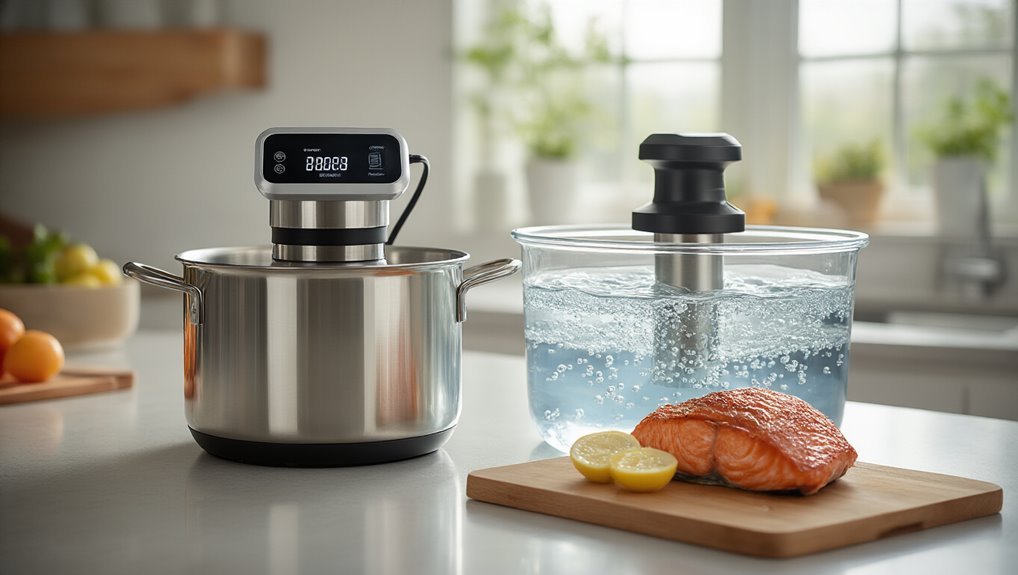
When you’re diving into the sous vide world, one of the first decisions you’ll face is choosing between immersion circulators and water baths. In my experience, the right choice depends largely on your kitchen setup and cooking needs.
Immersion circulators win on space efficiency – they clip onto pretty much any pot you already own, which I think is perfect if you’re working with a cramped kitchen like mine. Vessel compatibility is their superpower; you can use anything from a stockpot to a plastic container.
Vacuum sealing complements your sous vide setup by boosting Flavor preservation and extending storage life, which is especially helpful for long-term planning.
Water baths, on the other hand, are like the workhorses of sous vide. They’re standalone units with uniform heating that, well, might take up more counter space but really shine when you’re cooking multiple items at once.
Top Sous Vide Machines for Home Cooks in 2023 (Budget to Premium)
I’ve tested dozens of sous vide machines, and I’m convinced that temperature control is what really separates the good from the great.
If you’re on a budget, Monoprice’s Strata Home delivers impressive accuracy at around $80, while app integration in models like the Breville Joule Turbo offers convenience that you’ll appreciate once you’ve used it.
That focus on precision is why I highlight temperature control as the key factor that separates the good from the great.
Whether you’re just starting out or looking to upgrade your kitchen tech, there’s a perfect sous vide option that’ll match both your cooking style and budget.
Top Budget Picks
For many home cooks, finding a sous vide machine that doesn’t break the bank is the first priority.
I’ve found the Monoprice Strata Home to be an incredible value at around $80-99.
While price volatility can affect what you’ll pay, it’s consistently the most affordable reliable option.
It doesn’t offer fancy color options like some higher-end models, but honestly, who needs that?
If you’re willing to spend a bit more, the Anova Precision Cooker 3.0 gives you that sweet spot of functionality and affordability.
I particularly appreciate its onboard display—something the pricier Joule Turbo ($250) lacks despite its impressive heating capabilities.
In my experience, budget models are actually quieter (around 49 dB), which is a nice bonus when you’re cooking all day.
Temperature Control Matters
Why does temperature accuracy matter so much in sous vide cooking? Well, it’s basically the whole point!
When I’m cooking a perfect medium-rare steak or those delicate egg yolks, even a one-degree fluctuation can dramatically change your results.
Premium models like the Joule Turbo maintain temps within ±0.1–0.2°C, while cheaper units often suffer from sensor drift over time, wandering a full degree off target.
- Premium circulators provide real-time temperature monitoring that prevents cooking disasters
- Budget models can work well but require regular calibration checks against a reliable thermometer
- The difference between perfectly silky egg yolks and rubber is often just 1-2 degrees of accuracy
In my experience, if you’re serious about sous vide cooking, investing in temperature stability pays off with every meal.
App Integration Benefits
While temperature precision forms the backbone of sous vide cooking, modern machines offer another game-changing feature: app integration. I’ve found that connecting my sous vide to WiFi transforms the cooking experience by letting me monitor and adjust temperatures remotely—perfect when I’m entertaining guests or multitasking around the house.
Premium models like the Anova Precision and Breville Joule offer impressive app functionality with cooking guides and notifications.
Though, I should mention the WiFi security and privacy implications that come with connected kitchen appliances.
I mean, you’re basically putting your cooking data online, right?
But the convenience usually outweighs these concerns.
Budget-friendly options like the iVide series now include WiFi capabilities too, making remote cooking accessible without breaking the bank.
Restaurant-Grade Sous Vide Machines: Professional Models Worth the Investment
Restaurant-grade sous vide machines represent kitchen powerhouses that truly separate the pros from the amateurs.
When I’m evaluating professional models, I always check durability metrics and calibration routines first—these aren’t just features, they’re necessities for consistent results under pressure.
The Breville Joule Turbo, PolyScience Professional, and Julabo Fusion Chef stand out as investments worth making for serious kitchens.
- High-wattage models (1000-2000W) maintain stability even when you’re cooking multiple portions—I’ve found this essential during dinner rushes
- Stainless steel contact parts resist corrosion and withstand the daily abuse of professional kitchens
- App connectivity paired with precise displays gives you the best of both worlds—remote monitoring while maintaining hands-on control
5 Critical Features That Make or Break a Sous Vide Machine
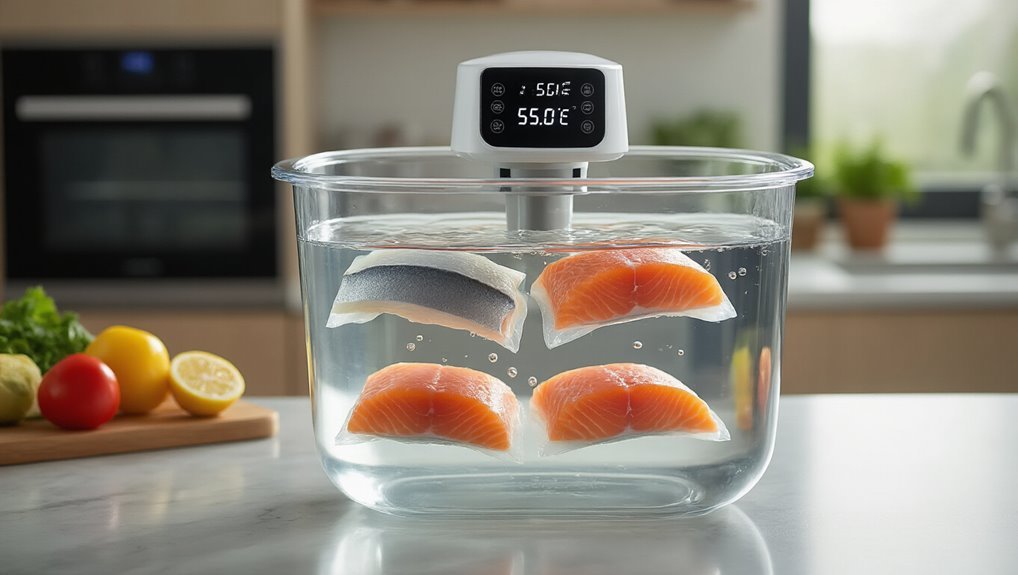
I’ve learned through years of testing that three features make or break any sous vide machine: precision temperature control (aim for 0.2°C accuracy), sufficient wattage (you’ll want at least 1200W for professional kitchens), and build quality that can withstand constant use.
A steady clamp and reliable vessel attachment are just as critical as the core specs, ensuring consistency across back-to-back services precision temperature control.
When I’m evaluating models for my restaurant, I always check how the machine attaches to different vessels and whether it offers modern monitoring capabilities –
trust me, you don’t want to be stuck with a flimsy clamp during dinner service. These might seem like small details, but they’re actually the difference between perfect results and inconsistent cooking that’ll frustrate you and disappoint your guests.
Precision Temperature Control
Why does precision temperature control matter so much when you’re choosing a sous vide machine?
It’s the difference between perfectly cooked food and disappointment.
When I’m cooking a delicate piece of fish or trying to achieve that exact medium-rare steak, even a half-degree fluctuation can change the result.
Top models maintain accuracy within 0.1-0.2°C of your target temperature, which I’ve found essential for consistent results.
- Temperature stability directly impacts protein texture – think silky egg custards versus rubbery disappointments
- Lower-cost units may experience sensor drift, requiring more frequent calibration schedules
- Premium circulators (like the Breville Joule Turbo) provide real-time feedback, helping you monitor performance without guesswork
I always recommend investing in the most precise circulator your budget allows.
The consistency is worth every penny.
Wattage Matters Most
The engine behind your sous vide machine—its wattage—might be the most overlooked yet essential factor when selecting your equipment. I’ve found that insufficient power budgets lead to temperature drift and inconsistent results, especially when you’re working with larger water baths.
In my experience, heater efficiency directly impacts how quickly your machine reaches target temperature and maintains it. When I’m cooking for more than just myself, I need at least 1200W to avoid frustrating delays.
| Setting | Recommended Wattage | Performance |
|---|---|---|
| Home Kitchen | 1000-1200W | Adequate for small batches |
| Small Restaurant | 1200-2000W | Maintains precision under load |
| High-Volume | 2000-7500W | Minimal temperature fluctuation |
Don’t skimp here—those 0.2°C variations might seem minor but, trust me, they’ll make or break your results.
Build Quality Essentials
Behind every exceptional sous vide cook stands a machine that won’t quit when the heat turns up.
I’ve learned through experience that stainless durability isn’t just a fancy feature—it’s absolutely essential for long-term performance.
When I’m shopping for a sous vide machine, I always check the contact points with water and make sure they’re high-quality stainless steel, not plastic that’ll warp over time.
- Reinforced clamps that won’t loosen after repeated use (trust me, nothing’s worse than finding your circulator at the bottom of the pot!)
- Water-resistant design with an IP rating—because splashes happen, especially in busy kitchens
- All-metal construction around heating elements to prevent cracking when temperatures fluctuate
Power, Precision, and Performance: Understanding Sous Vide Machine Specifications
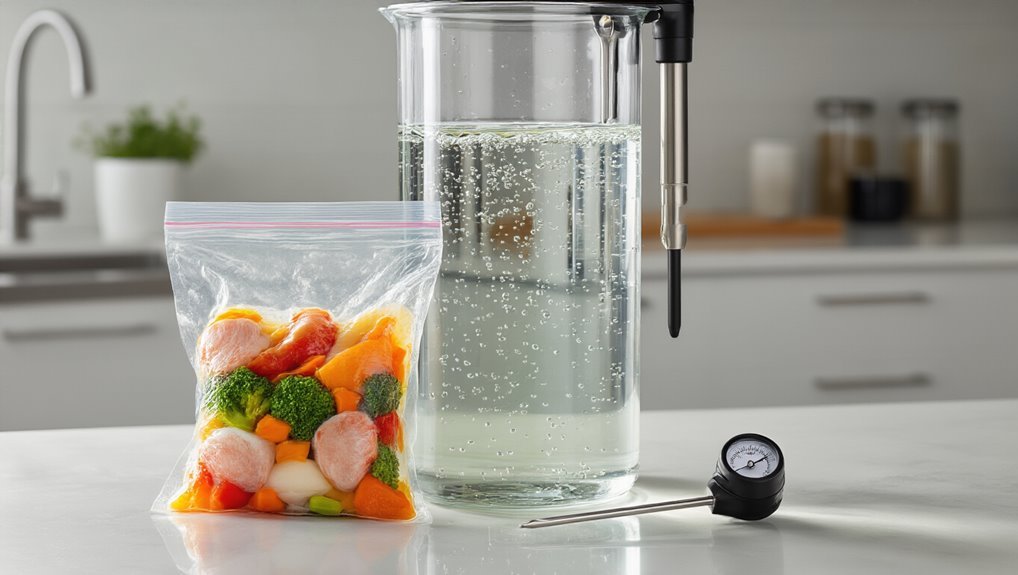
When diving into sous vide cooking, understanding the technical specifications of machines becomes vital for success.
I’ve found that power requirements are key—professional units need at least 1200W, with commercial models typically around 2000W to maintain stable temperatures in larger baths.
Power means precision—professional sous vide units demand 1200W minimum, while commercial setups require 2000W for larger water baths.
For precision cooking, temperature accuracy is everything.
Look for units with ΔT of 0.2°C or less—the Breville Joule Turbo and Anova Pro achieve impressive accuracy between ±0.1°C and ±0.07°C.
When checking voltage compatibility, guarantee your kitchen’s setup can handle the power draw without affecting pump longevity.
While heating speed is nice (higher wattage means faster preheating), I think precision matters more than speed.
What you really want is consistent circulation that eliminates hot and cold spots, giving you perfectly even cooking results every time.
Smart Sous Vide: How App Control and Connectivity Enhance Your Cooking
Why have modern sous vide machines become so connected? I think it’s simple—convenience meets precision. With my Breville Joule, I can start dinner while stuck in traffic, receive notifications when my water’s ready, and never worry about overcooking.
Though app security concerns exist (always use strong passwords!), the benefits outweigh potential risks.
- Remote temperature adjustments when I’m entertaining guests or multitasking elsewhere in the house
- Stored cooking profiles that remember exactly how I like my steaks—no more guesswork
- Real-time monitoring that lets me know if something’s wrong, though occasional cloud latency can be annoying
While I’d never rely solely on app-based timers (um, phones die!), the connectivity transforms cooking from a guessing game into a reliable science experiment—with delicious results.
Essential Accessories to Pair With Your New Sous Vide Machine
The perfect sous vide setup doesn’t end with just the machine—I’ve learned this the hard way after ruining several meals with improper equipment.
Trust me, proper vacuum seals make all the difference.
I invested in a chamber sealer for my marinades, and honestly, it’s been a game-changer compared to those zip-top bags that leaked everywhere.
For long cooks, I’d recommend grabbing an insulated lid—it cuts down on evaporation dramatically.
Oh, and don’t forget about rack organization!
I used to have bags touching and cooking unevenly until I got a stainless steel rack.
Now everything cooks perfectly spaced out.
I’m also a huge fan of those little vacuum balls.
They’re probably not essential, but they keep my water temperature super stable during 48-hour brisket cooks.
Chamber vacuum sealers offer reliable chamber sealing to handle liquids, ensuring leak-free sealing.
Frequently Asked Questions
What Is the Best Sous Vide Machine for Home Use?
I’d recommend the Monoprice Strata Home Sous Vide for ideal taste profiles at home. It’s affordable at $80-99, easy to maintain (just wipe clean), and impressively accurate for consistent cooking results.
How to Choose a Sous Vide Machine?
I’ll cut to the chase: consider your budget first, then look for controller features that suit your cooking style. Temperature accuracy and power should be the bottom line for any sous vide purchase.
What Is the Downside of Sous Vide?
I’ve found sous vide creates texture changes in some foods that can feel mushy. It also generates significant plastic waste from all those bags. The equipment investment and storage needs aren’t trivial either.
What Wattage Sous Vide Do I Need?
I’ve been asked this question a million times! For home use, 800-1200W balances power consumption and energy efficiency perfectly. Professional kitchens need 2000W+ for faster recovery when adding cold food.