I’ve been dabbling in the noble art of botanical extraction lately, and I gotta say, my sous vide setup has been a game-changer. When you seal those fragrant herbs in oil or high-proof spirits, something magical happens at those precise low temps. I think it’s the gentle heat that coaxes out flavors you’d miss with traditional methods. Maybe it’s just me, but there’s something almost meditative about watching those colors slowly infuse—and wait till you taste what happens when you experiment with different time variables!
Essential Equipment for Sous Vide Soap Oil Infusions
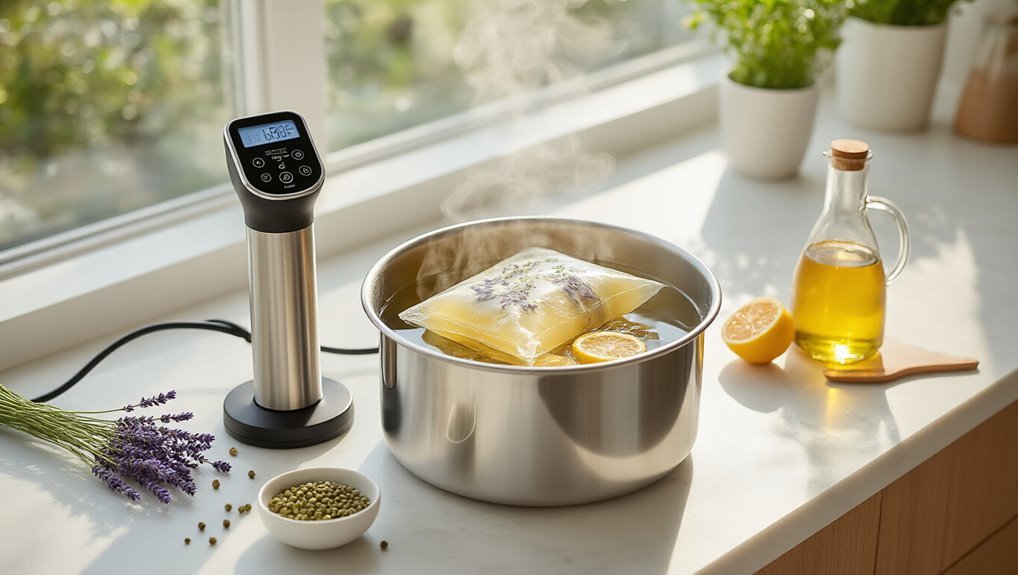
Assembling your essential equipment for sous vide soap oil infusions isn’t just important—it’s the foundation of your success.
I’ve found that airtight jars are absolutely essential—they create that sealed environment where your ingredients can properly meld with the oil without oxygen interference.
You’ll definitely want a good vacuum sealer or, at minimum, jars that seal extremely well.
I think of these as my flavor vaults—they lock everything in while the magic happens.
Don’t forget about straining tools!
I use both fine strainers and cheesecloth in sequence.
Oh, and an immersion circulator is non-negotiable—it maintains those precise temperatures in the low 100s that extract flavors without damaging them.
A muddler helps too, especially for herbs that need a little… persuasion to release their oils.
This is where precise temperature control and consistent circulation come into play, ensuring even heat distribution throughout the oil infusion.
How Sous Vide Temperature Control Enhances Oil Extraction
While I’ve dabbled with many oil infusion techniques over the years, nothing has revolutionized my process quite like the precise temperature control that sous vide offers.
Maintaining steady temps between 135-160°F eliminates those frustrating temperature gradients that can scorch oils or leave extractions incomplete.
I’ve found that diffusion rates dramatically improve in vacuum-sealed environments.
When oxygen can’t interfere with the process, aromatic compounds transfer more effectively into the oil base.
It’s like giving the molecules a direct highway instead of a congested city street.
- Lower temps (130-145°F) preserve delicate flavors
- perfect for citrus or floral notes
- Mid-range settings (145-155°F) balance extraction with preservation
- Higher temps (155-160°F) accelerate extraction for bolder infusions
The consistency I’m achieving batch after batch is honestly game-changing. This is why vacuum sealing supports faster, more uniform extractions by reducing air pockets.
Selecting the Best Base Oils for Soap Infusions
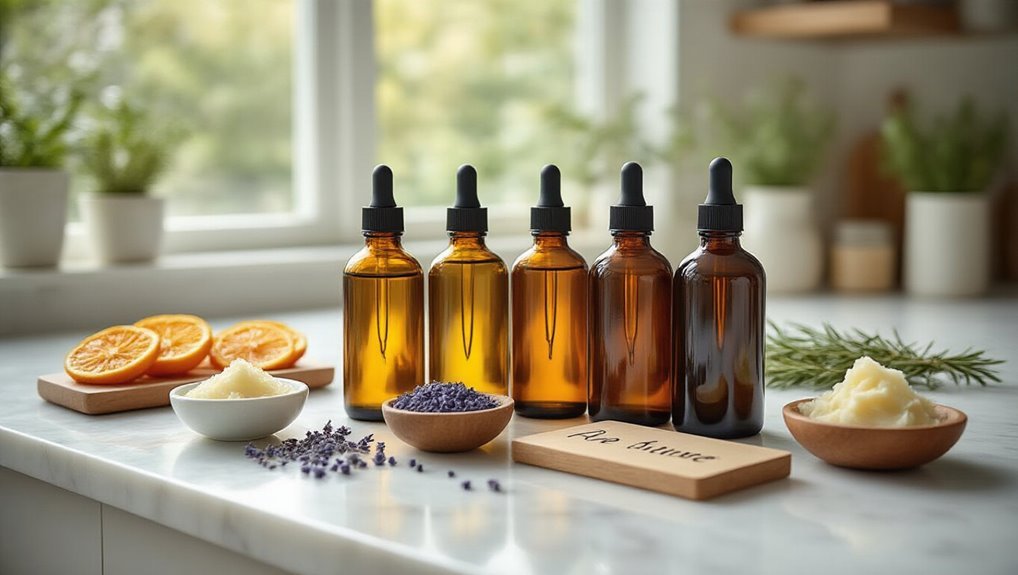
I’ve found that selecting the right base oil for your sous vide soap infusions makes all the difference in the final product’s quality and character.
When I’m choosing carrier oils, I always consider their saturation levels versus stability—highly saturated fats like coconut and butter tend to hold botanicals’ properties more effectively than their unsaturated counterparts.
You’ll want to match your botanical ingredients with compatible base oils—for example, floral elements often pair beautifully with lighter oils while woody or earthy additives might need something with more substance like sesame oil.
Carrier Oil Properties
The foundation of successful soap infusions lies in your carrier oil selection—it’s not just a neutral base but an active participant in the final product’s quality.
I’ve found that melting behavior dramatically impacts how evenly flavors distribute during sous vide infusion.
Oils that easily shift from solid to liquid and back tend to, well, capture more complex notes in my experience.
When choosing your carrier, I focus on three critical aspects:
- Shelf stability – nobody wants a beautifully infused oil that rancidifies before you’ve even used it
- Skin compatibility – the oil must be gentle enough for topical use
- Melting point consistency – ideally between 76-104°F for sous vide control
I always recommend testing small batches first.
You might be surprised—sometimes coconut oil captures tropical notes that butter simply can’t match!
Saturation Versus Stability
Why do some oils hold fragrance beautifully while others turn rancid within weeks?
I’ve found that saturation dynamics play a vital role in this puzzle.
Highly saturated fats like butter tend to be more stable for sous vide infusions than their unsaturated counterparts.
When I’m creating fat washes, I’m constantly balancing stability tradeoffs.
Butter works wonderfully as a carrier, but sometimes I’ll reach for sesame oil when I want a different flavor profile.
Either way, I always use my sous vide setup—it’s brilliant for controlling temperature while minimizing evaporation.
Don’t forget to refrigerate your finished infusions!
I learned this the hard way once.
Trust me, nothing’s worse than discovering your beautiful butter-fat infusion has developed that unmistakable rancid smell.
Always check for off flavors before using.
Botanical Compatibility Factors
Now that we’ve covered stability in fat washes, let’s examine how botanical elements pair with different carrier oils for soap making.
I’ve found that taste compatibility and aroma compatibility are essential when selecting your base oils.
You want something neutral that won’t fight with your chosen botanicals.
In my experience, refined carrier oils work better than those with strong inherent flavors.
- Choose oils with high smoke points (like sunflower or rice bran) to prevent breakdown during the sous vide process
- Match oil viscosity to your filtration method – thinner oils filter more easily but might need multiple passes
- Consider the oil’s natural scent profile – some, like coconut, have their own aroma that might clash with delicate botanicals
Sous Vide Temperature and Time Charts for Soap Oils
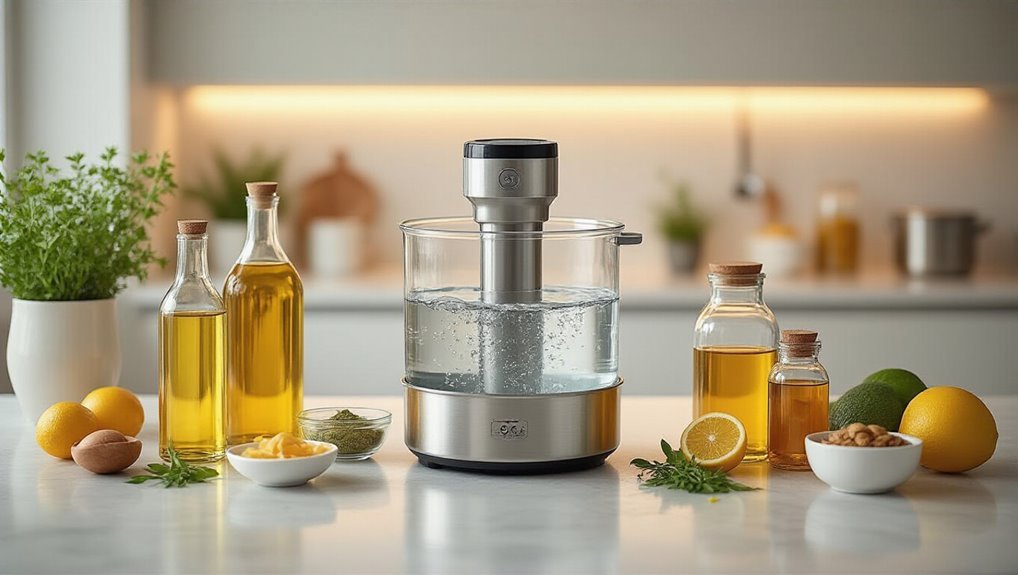
When crafting soap using sous vide infused oils, I’ve found that precise temperature and time control can make or break your final product.
I typically work in the 130°F to 160°F range, with most of my successful infusions happening around 145°F for about 2 hours.
For temperature validation, I can’t stress enough how important it’s to check your equipment before each batch. Those lower temps (around 130°F) give you gentler notes, while cranking it up to 160°F produces more robust, almost cooked qualities—sometimes too intense for delicate soaps.
Batch tracking is essential if you’re making multiple batches. I once forgot to document my garlic oil infusion parameters and couldn’t reproduce that amazing batch. Trust me, your future self will thank you for keeping detailed records!
This approach mirrors the core of precise temperature control that makes reliable sous vide infusions possible.
Herb and Botanical Infusions for Soap Fragrances
The world of herb and botanical infusions for soap fragrances opened up entirely new creative possibilities once I discovered sous vide techniques.
I’ve found that botanical sourcing makes all the difference—fresh ingredients capture brighter aromas than dried ones.
When infusing oils at 130-160°F, I can extract delicate scents in just 1-3 hours without the oxidation that dulls those beautiful notes.
- Crush or chop herbs like basil and rosemary to increase surface area before sealing in glass jars
- Combine complementary botanicals (try citrus peels with vanilla beans for depth)
- Strain through fine filters for clarity and purity
Proper fragrance aging is essential—I keep my infusions refrigerated and test them periodically.
Heat and light are the enemies of those subtle herbal notes I work so hard to capture!
Precise Temperature control in the water bath ensures consistent extraction without scorching delicate notes.
Colorant Infusions: Creating Naturally Tinted Soap Oils
Colorful transformations happen when you merge art with science in soap making, and I’ve discovered sous vide provides perfect control for natural colorant infusions.
I typically use the same approach as flavor infusions: sealing botanicals in oil at 135-160°F for 1-3 hours draws those gorgeous pigments right into your base.
For best color chemistry results, I’ve found using the same materials that give great flavor—think citrus peels or vibrant herbs—creates beautiful, harmonious tints.
After infusing, strain thoroughly through fine filters to prevent haziness.
Pigment stability is, honestly, a bit tricky.
I always store my tinted oils in the fridge or a cool, dark cabinet.
And definitely start with small test batches first—too much heat can actually shift the colors in weird, sometimes muddy ways.
Preserving and Storing Your Sous Vide Infused Soap Oils
Now that you’ve mastered creating those vibrant infusions, proper storage becomes your next soap making mission. I’ve learned that fridge longevity is no joke—cooling your oils immediately after infusion greatly extends their shelf life. Trust me, you’ll want airtight storage containers to prevent any contamination or unwanted odor transfer.
To lock in freshness and prevent leaks, consider vacuum sealing liquids as part of your storage strategy.
I always filter my infusions at least twice. Sometimes three times if I still see any cloudiness. Actually, I should say—thorough filtration is essential, not just convenient.
- Label everything with dates and ingredients (future you’ll thank present you)
- Store in cool, dark places if fridge space is limited
- Check regularly for signs of rancidity—bitter taste or off smells mean it’s time to toss
Troubleshooting Common Sous Vide Oil Infusion Problems
I’ve found that maintaining precise temperature control is probably the most essential factor in preventing scorched ingredients and bitter flavors in your sous vide oil infusions.
Using vacuum sealing can further improve infusion efficiency by minimizing air exposure and ensuring consistent flavor capture.
When your herbs or spices start to taste burnt or your oil turns cloudy, try reducing the temperature by 5-10 degrees and adjusting your infusion time accordingly.
For those times when you’re not getting enough flavor punch, I recommend finely chopping your ingredients and making sure they’re completely submerged in oil before sealing your container tightly.
Temperature Control Issues
When your sous vide oil infusion goes awry, temperature control issues are often the main culprit.
I’ve found that temperature drift can completely ruin what should be a simple process.
You’ll want to guarantee your water bath maintains heat uniformity throughout the entire cooking time.
In my experience, those little fluctuations that seem harmless? They’re actually sabotaging your oils by causing uneven extraction.
- Never let your oil reach its smoke point—this creates bitter, off-putting flavors that you can’t salvage
- Use a vacuum-sealed container to promote consistent heat transfer (I learned this one the hard way!)
- Start with moderate infusion times and log everything—temperature, duration, cooling method—so you can replicate your successes
Preventing Ingredient Scorching
Despite your best efforts, ingredient scorching remains one of the most frustrating problems you’ll encounter with sous vide oil infusions.
I’ve learned that the key to burn prevention lies in a gentle heat technique—always keep temperatures low and warm up gradually.
Trust me, rushing this process is a recipe for disaster.
I start with shorter infusion times and lower strengths, then taste and adjust.
This approach gives me better control over extraction without risking that burnt flavor we all hate.
Don’t forget to filter thoroughly!
I usually run my infusions through multiple filters to catch those tiny particles that might burn later.
And remember, quality ingredients matter.
If something tastes off before infusion, it’ll probably taste scorched after heating.
When you’re done, chill immediately to preserve all that flavor you’ve carefully extracted.
Maximizing Flavor Extraction
Why does your sous vide oil infusion taste flat despite using premium ingredients?
In my experience, maximizing flavor extraction comes down to understanding solvent effects and perfecting your diffusion strategies.
I’ve found that even the finest herbs won’t shine without the right technique.
- Increase surface area by grinding ingredients finely, which dramatically improves the solvent effects of oil penetrating cellular structures
- Maintain precise temperature control between 130–160°F—go too low and you’ll get weak flavor, too high and you’ll cook off delicate compounds
- Extend infusion time strategically—some ingredients need the full 3 hours, but others might get bitter
When I’m troubleshooting a bland infusion, I first check my documentation. Did I vacuum seal properly? Was my ingredient completely dry? Remember, oil and water don’t mix, so moisture can actually block diffusion.
Frequently Asked Questions
How to Infuse Oil With Sous Vide?
I seal my herbs in neutral oil, sous vide at 135-150°F for proper timing (1-3 hours), then quickly chill to lock in citrus notes before straining and refrigerating my infusion.
What Is the Best Temperature to Infuse Oil?
I’d recommend 135-150°F for oil infusions, staying well below your oil’s smoke point. This temperature range extracts flavors beautifully without damaging delicate oils or creating bitter compounds.
What Are the Best Infusions for Alcohol?
Like Prometheus gifting fire, I’ll share my favorites: citrus peels and vanilla for vodka, fresh herbs for gin, warming spice profiles like cinnamon for rum, and vibrant fruit essences for any spirit.
What Is the Downside of Sous Vide?
I’ve found sous vide infusions carry texture risk if overcooked, plus safety concerns from potential bag ruptures. It’s also costly, requires extra equipment, and can over-extract, creating bitter flavors if I’m not careful.