I remember my first sous vide experiment—a steak that came out perfectly pink from edge to edge. It was a revelation. When you understand the science behind sous vide, you’re not just cooking; you’re conducting a controlled experiment where water becomes your most reliable assistant. The physics is straightforward: water transfers heat more efficiently than air, eliminating temperature gradients that plague traditional methods. But there’s more to this technique than just precise temperatures.
What Is Sous Vide: The Science of Water Bath Precision Cooking
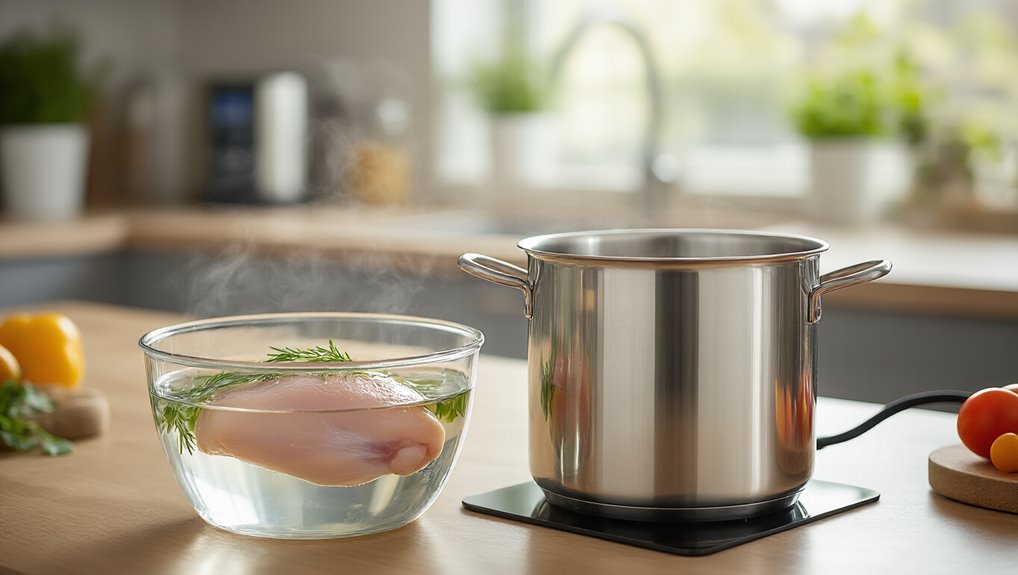
How exactly does cooking food in a bag underwater yield some of the most perfectly cooked meals you’ll ever taste?
It’s all about precision and control.
When I first discovered sous vide, I was amazed by how this technique—with historical origins dating back to the 1970s—transforms cooking from guesswork to science.
The magic happens through heat transfer via water rather than air.
Unlike traditional methods where heat blasts your food, water conducts heat more efficiently and uniformly.
Equipment evolution has brought us from primitive setups to sleek immersion circulators that maintain temperatures within 0.1°F.
Think of it like this: instead of hoping your steak hits medium-rare, you’re guaranteeing it by setting the exact temperature.
No more overcooked edges or undercooked centers—just perfection, edge to edge.
Vacuum sealing enhances heat transfer, locking in moisture while removing air pockets to ensure uniform, precise results.
How Sous Vide Transforms Food: Temperature Control vs. Traditional Methods
When I compare sous vide cooking to traditional methods, I’m constantly amazed by the transformative power of precise temperature control.
Precise temperature control in sous vide cooking revolutionizes the culinary experience in ways traditional methods simply cannot match.
The science behind precision cooking hinges on temperature control, the key to avoiding the outer overcook while preserving interior juiciness.
Traditional cooking blasts food with high, variable heat, causing those outer parts to overcook while you’re waiting for the center to reach doneness.
Sous vide, on the other hand, maintains that perfect temperature—like 130°F for certain meats—throughout the entire cooking process.
I’ve found this approach actually reduces energy usage since you’re using lower temperatures for longer periods.
Plus, the equipment maintenance is pretty minimal compared to cleaning baked-on messes from ovens or pans.
The magic really happens around 140°F.
Below this threshold, muscle fibers stay relaxed and juicy, while collagen slowly transforms into gelatin.
It’s kinda like getting the best of both worlds—tenderness and flavor.
Why Water Conducts Heat Better Than Air in Sous Vide Cooking
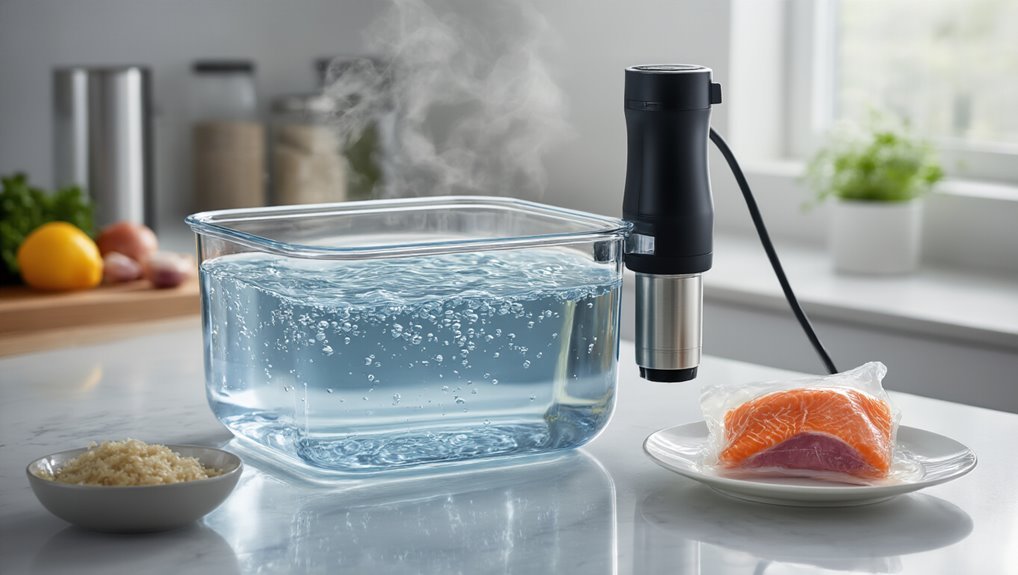
The secret behind sous vide’s remarkable consistency lies in water’s extraordinary heat-conducting properties.
I’ve found that water transfers heat about 25 times more efficiently than air does, which is pretty amazing when you think about it.
This means your food cooks evenly throughout, without those frustrating thermal gradients you get with oven cooking.
When an immersion circulator creates constant water movement, it eliminates circulation variance that would normally create hot and cold spots.
It’s like having a perfectly uniform cooking environment hugging every surface of your food.
I think water’s higher heat capacity is what makes sous vide so foolproof – it gently brings food to exact temperatures that would be, well, practically impossible to maintain using air.
That precision temperature control is what makes the technique reliably reproduce textures across different ingredients.
The physics is fascinating, isn’t it?
The Science Behind Sous Vide’s Moisture Retention Advantage
I’m fascinated by how sous vide creates juicier meat through a delicate transformation of protein structures that prevents the harsh contractions we get with high-heat cooking.
The combination of precise temperature control and time ensures proteins unfold gradually rather than shock, preserving moisture.
When proteins heat gradually in their sealed environment, they maintain osmotic pressure balance, allowing meat to hold onto moisture that would otherwise be lost.
The physics of heat transfer plays an essential role too—the gentle, even warming from water surrounds the food completely, ensuring every molecule cooks at precisely the right temperature without pushing precious moisture out.
Protein Structure Transformation
Understanding how proteins transform during cooking reveals why sous vide produces such remarkably moist results.
When I cook meat traditionally, protein denaturation shifts happen rapidly and unevenly, causing excessive shrinkage and moisture loss.
In sous vide, I’m controlling this process with surgical precision.
At temperatures below 140°F, muscle fibers contract horizontally rather than vertically, which—trust me—makes a huge difference in juice retention. The slow, controlled heat prevents aggressive protein crosslinking that would otherwise squeeze moisture out like wringing a sponge.
What’s fascinating is how the vacuum seal works alongside this gentle cooking.
Without air exposure, there’s nowhere for the moisture to escape.
It’s like, um, giving the meat a protective shield while those proteins are transforming into their final, juicy form.
Osmotic Pressure Balance
Diving deeper into moisture retention reveals a fascinating molecular dance happening inside your vacuum-sealed bags.
I’m always amazed at how sous vide maintains cell turgor—the internal pressure that keeps tissues firm and juicy.
What’s really happening is a perfect isotonic diffusion balance.
When you vacuum seal foods, you’re creating an environment where water doesn’t rush to escape from cells.
Unlike traditional cooking where moisture evaporates quickly, sous vide’s sealed, submerged method preserves the natural osmotic pressure balance.
Think of each cell like a tiny water balloon—traditional cooking pops many balloons, but sous vide keeps them intact.
The gentle, precise temperatures avoid protein denaturation that would otherwise disrupt water-holding capacity.
It’s basically—well, it’s actually the closest thing to cellular harmony you can achieve in cooking.
Heat Transfer Physics
The hidden physics of heat transfer explains why sous vide creates the juiciest foods you’ll ever taste. When I cook traditionally, radiative transfer and convection whisk moisture away quickly. But in sous vide, I’m leveraging water’s superior heat conductivity while blocking those moisture-stealing diffusion processes.
| Heat Method | Temperature | Moisture Loss | Texture Result |
|---|---|---|---|
| Oven (dry) | 350-450°F | High (15-25%) | Often dry |
| Pan searing | 400-500°F | Medium-high | Varies widely |
| Sous vide | 130-185°F | Minimal (5%) | Consistently juicy |
| Water boil | 212°F | Medium | Can be tough |
You know, it’s fascinating how water transfers heat about 23 times more efficiently than air, while the vacuum seal prevents those pesky evaporation effects that normally dry out your food. I think that’s really the magic combination.
How Proteins React at Different Sous Vide Temperatures
Why does protein behave so differently at various temperatures in sous vide cooking?
It’s all about denaturation kinetics and amino exposure.
When I cook below 140°F, something magical happens—muscle fibers contract horizontally, locking in moisture rather than squeezing it out.
Think of proteins as tightly wound coils that, um, they gradually unfold as heat increases.
Above 140°F, those same fibers shrink lengthwise instead, which is why your meat might end up drier if you’re not careful.
I love how sous vide’s precision eliminates that old-school gradient between rare center and well-done edges.
The slow, even heating gives collagen time to transform into gelatin while proteins restructure uniformly.
It’s like giving the meat a gentle spa treatment rather than a harsh workout!
Vacuum Sealing Benefits: Beyond Just Removing Air
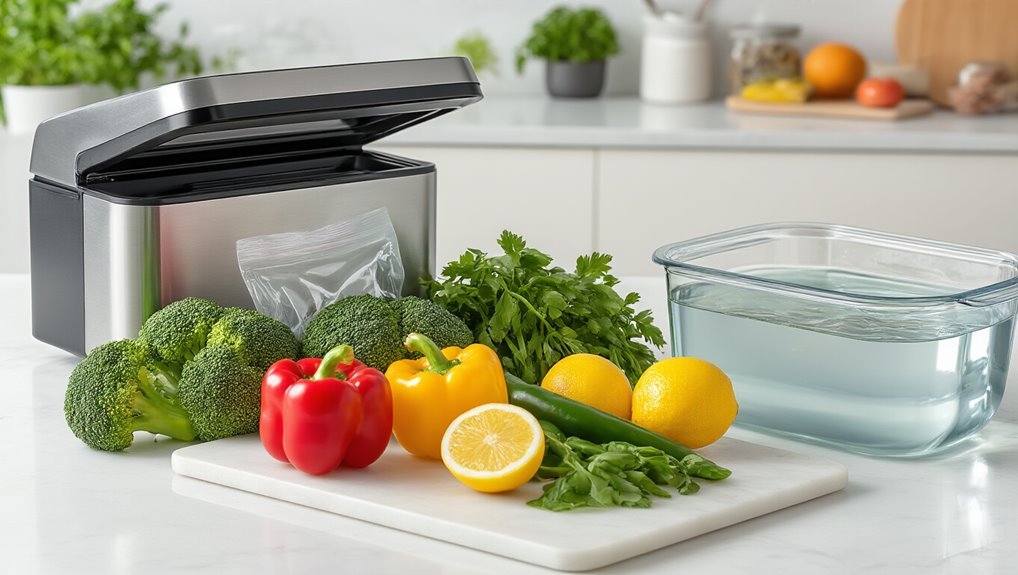
I’ve found that vacuum sealing isn’t just about removing air – it’s actually the gateway to superior heat transfer in sous vide cooking.
When your food is perfectly sealed, heat from the water bath conducts more efficiently through the package, creating that edge-to-edge consistency we’re all after.
Plus, I think it gives you incredible control over flavor infusion, allowing spices and marinades to penetrate more deeply since they’re pressed directly against the food rather than floating around in the bag.
Vacuum sealing not only speeds flavor penetration but also dramatically improves preservation Enhanced Preservation by removing air.
Heat Transfer Efficiency
Many enthusiasts don’t realize that vacuum sealing in sous vide cooking goes far beyond simply removing air from the cooking pouch.
It’s actually a game-changer for heat transfer efficiency.
When I vacuum seal food, I’m eliminating those pesky air pockets that create thermal gradients and act as insulators.
Think of it like this: the bag becomes a second skin around your steak.
With maximum contact between the food and water bath, heat transfers more uniformly—no eddy currents disrupting the process.
I’ve found that sealed foods cook more evenly and often faster.
What’s really impressive, though, is how the seal locks in moisture, which further enhances conductivity.
Your food basically cooks in its own juices, preserving flavors that would otherwise escape into the water bath.
Flavor Infusion Control
Have you ever noticed how flavors seem to intensify dramatically in sous vide cooking? That’s not accidental—it’s science! When I vacuum seal proteins or vegetables, I’m creating the perfect environment for marinade diffusion. The tight seal forces flavors into the food rather than letting them escape.
| Sealing Effect | Flavor Impact | Cooking Result |
|---|---|---|
| Aroma locking | Preserves volatiles | Deeper taste profile |
| Juice retention | Concentrates flavors | More succulent food |
| Marinade compression | Enhances penetration | Consistent seasoning |
In my experience, even a simple herb butter becomes transformative when vacuum sealed with chicken. The pressure actually pushes flavor compounds into the meat’s structure. It’s like the difference between dipping bread in olive oil versus the oil being trapped inside—you’ll taste what I mean immediately!
Ensuring Food Safety in Sous Vide: Understanding Time and Temperature
When it comes to sous vide cooking, safety isn’t just a suggestion—it’s absolutely essential.
I’ve learned that proper hazard analysis means understanding that different pathogens require specific time-temperature combinations. For example, you’ll need more aggressive treatment for Salmonella (10,000,000:1 reduction) than for E. coli.
Your food’s center should reach 130°F within 6 hours—no exceptions.
Otherwise, you’re basically creating a perfect environment for bacterial growth. I always follow strict cooling protocols after cooking; an ice-water bath is my go-to method.
Think of temperature danger zones like a highway—you want to pass through quickly, not linger.
Food shouldn’t stay between 41°F and 130°F for more than 4 hours during processing.
After that? Well, refrigerate promptly or freeze for longer storage.
Additionally, using food-grade bags reduces the risk of plastic contaminants and chemical leaching.
How Sous Vide Preserves Texture in Different Foods
I’ve found that sous vide’s magic lies in how it transforms the texture of different foods in ways traditional cooking simply can’t match.
The method’s core is precise temperature control that lets proteins remain juicy and collagen convert at lower temperatures, producing melt-in-your-mouth tenderness.
When I cook meat this way, proteins stay juicy and collagen converts to gelatin at lower temperatures, giving me that melt-in-your-mouth tenderness without the typical shrinkage.
For vegetables and fish, it’s all about maintaining their natural structure—vegetables remain crisp yet tender, while delicate fish holds together perfectly instead of falling apart like it might on a hot grill.
Meat Protein Transformation
Why does meat cooked sous vide turn out so perfectly tender compared to traditional methods?
It’s all about the gentle transformation of proteins.
When I cook below 140°F, I’m preventing those muscle fibers from contracting horizontally, which is what squeezes out moisture.
Traditional cooking can’t match this precision.
What I find fascinating is how sous vide enables enzymatic cleavage of collagen starting around 130°F.
Over time, these enzymes break peptide bonding in tough connective tissues, converting them to rich gelatin without toughening the surrounding meat.
The water bath’s uniform temperature is actually the secret weapon here.
Instead of that gradient from well-done edges to rare centers, every protein molecule experiences the same gentle heat.
That’s why my sous vide steaks are juicy from edge to edge.
Vegetable Cell Integrity
Vegetable cells tell a completely different story when cooked sous vide versus traditional methods.
I’ve found that traditional high-heat cooking absolutely destroys cell walls, leading to that mushy texture we all hate.
It’s like watching a building collapse!
When I cook vegetables sous vide, I’m actually preserving their turgor pressure—that’s the internal pressure that gives veggies their satisfying snap.
By keeping temperatures below 185°F, I prevent pectin from breaking down too quickly.
Think of pectin as the mortar between bricks in cell walls.
What I love most about sous vide for vegetables is the uniformity.
The water bath surrounds everything evenly, so you don’t get those overcooked outer layers while the inside remains, um… what’s the word?
Oh right—underdone.
Fish Delicate Structure Preservation
Just like vegetables, fish presents its own unique challenge in the kitchen—and sous vide handles it brilliantly.
I’ve found that fish’s delicate structure demands precision that traditional methods can’t always deliver.
When salmon cooks at 122°F, it transforms into something silky and tender that conventional cooking just can’t match.
The magic happens because:
- Low temperatures prevent muscle fibers from contracting too much, preserving the fin biomechanics that give fish its natural texture
- Vacuum sealing minimizes lipid oxidation that can create those “fishy” notes nobody wants
- Precise temperature control keeps proteins from toughening, especially at the edges
- The sealed environment locks in moisture, yielding that melt-in-your-mouth quality
I think it’s the difference between good fish and transcendent fish.
Flavor Science: Why Sous Vide Creates More Intense Tastes
Have you ever noticed how food cooked sous vide seems to pack a more powerful flavor punch than conventionally prepared dishes? It’s not your imagination! The sealed environment creates perfect conditions for aroma diffusion, trapping those volatile compounds that typically evaporate during traditional cooking. I’ve found that taste concentration happens naturally when food cooks in its own juices rather than losing them to a pan or grill. This approach also enhances Food Safety by minimizing air exposure that can harbor bacteria.
| Flavor Element | Traditional Cooking | Sous Vide Effect |
|---|---|---|
| Aromatics | Escape into air | Locked in food |
| Fats & Juices | Often lost | Fully retained |
| Flavor Depth | Surface-dominant | Uniform throughout |
The precision of water bath cooking lets me develop flavors more fully without overcooking. When I finish with a quick sear, I’m basically creating the perfect storm of taste intensity!
Finishing Techniques: Adding the Perfect Sear to Sous Vide Foods
Why does perfectly sous vide cooked food often look so underwhelming until it’s properly finished?
The answer lies in crust formation—that beautiful Maillard reaction that transforms pale meat into a mouthwatering masterpiece.
That crust is all about the Maillard reaction, which flourishes when the surface is dry and the pan is screaming hot.
I’ve found that nailing the perfect sear comes down to technique.
For that restaurant-quality finish, follow these steps:
- Pat your meat completely dry—moisture is the enemy of a good sear
- Use a screaming hot pan with high smoke-point oil
- Develop a consistent searing cadence (I like flipping every 30 seconds)
- Add butter and aromatics only in the final moments
Frequently Asked Questions
What Is the Science Behind Sous Vide Cooking?
I rely on precise temperature control to denature proteins at specific temperatures, while molecular diffusion allows flavors to penetrate evenly throughout my food during the long cooking process.
What Is the Science Behind Pressure Cooking?
Pressure promotes powerful cooking through steam dynamics. I’m fascinated by how increased pressure raises water’s boiling point, creating superheated steam that penetrates food faster while enhancing flavor extraction from tough ingredients.
Is Sous Vide Under Pressure?
No, sous vide isn’t actually under pressure. I’m simply sealing food in a vacuum bag for better temperature distribution and bag integrity while cooking at precise, low temperatures in water.
Is Pressure Cooking the Same as Sous Vide?
Like night and day, pressure cooking isn’t the same as sous vide. I’ll debunk equipment myths: they use different devices and methods. Pressure cooking is fast, while sous vide embraces time variance for precision.